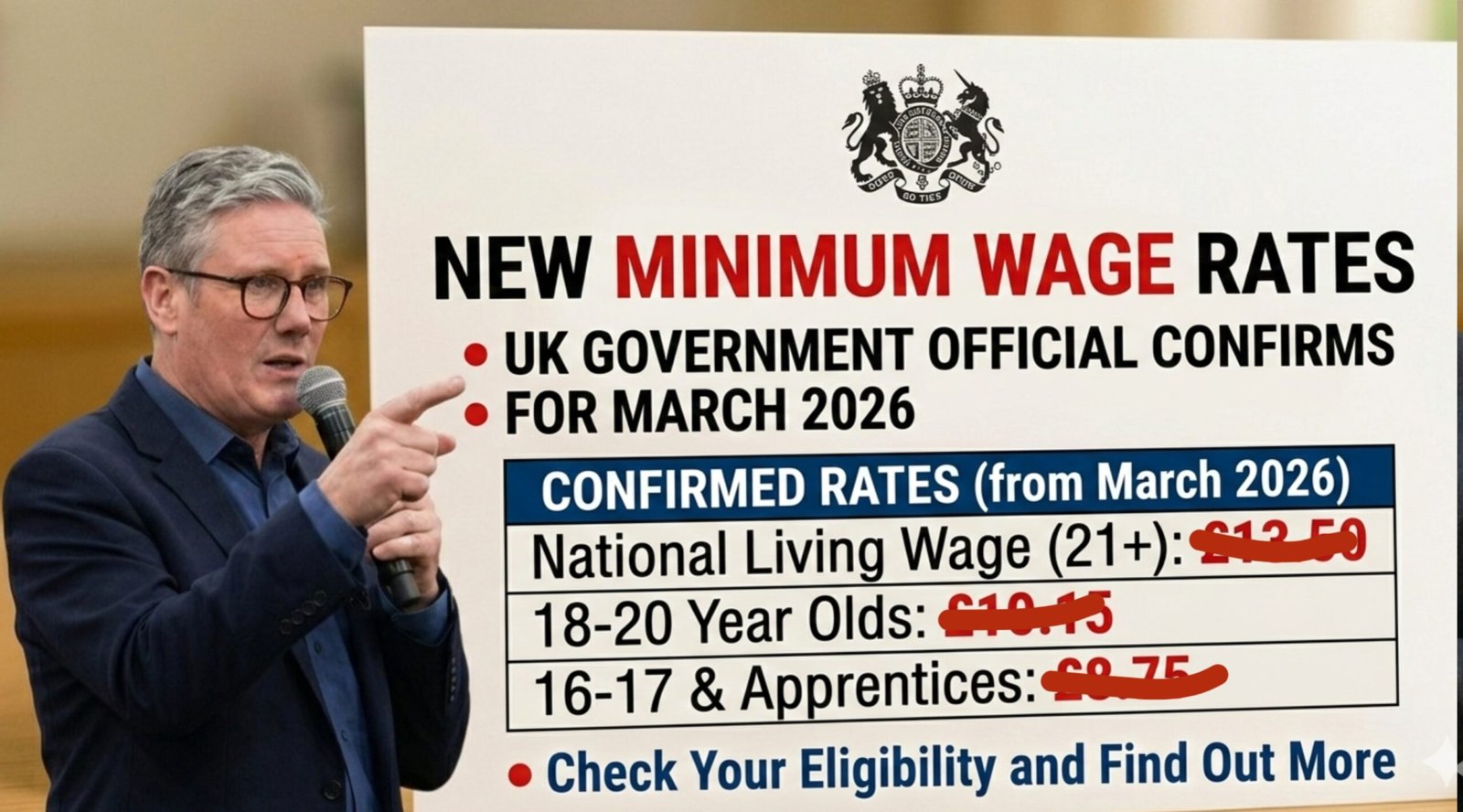
In a significant move that will impact millions of households across the country, the UK government has formally confirmed the new National Minimum Wage and National Living Wage rates. While these changes are legally set to take effect on 1 April 2026, the official confirmation this March provides a crucial window for businesses to adjust their payrolls and for workers to calculate their upcoming take-home pay.
This latest adjustment comes at a pivotal time for the British economy. With the cost of living remaining a primary concern for the workforce, the government’s decision to accept the Low Pay Commission’s (LPC) recommendations in full aims to protect the lowest-paid members of society while balancing the operational pressures on small businesses. For the first time, we are seeing a deliberate and aggressive push to narrow the gap between different age brackets, moving closer to a unified “adult rate” for everyone in the workforce.
The New National Living Wage for 21 and Over
The headline figure in this announcement is the increase in the National Living Wage (NLW), which applies to all workers aged 21 and over. From April 2026, the rate will rise from £12.21 to £12.71 per hour. This 50p increase represents a 4.1% rise, which officials state is designed to keep pace with median earnings growth across the UK.
For a full-time worker on a standard 37.5-hour week, this change translates to an annual pay boost of approximately £975 before tax. Government ministers have highlighted that this keeps the UK on track to ensure the National Living Wage does not fall below two-thirds of the median hourly earnings—a benchmark used to define and combat “low pay.”
Substantial Pay Boost for Younger Workers
Perhaps the most dramatic news in the March confirmation is the sharp increase for workers aged 18 to 20. In an effort to align youth pay more closely with the adult rate, the government is increasing the National Minimum Wage for this age group from £10.00 to £10.85 per hour.
This 8.5% jump is significantly higher than the percentage increase for older adults. It reflects a growing consensus that younger workers often face the same essential living costs—such as rent and transport—as their older counterparts. By narrowing this gap, the DVLA and Department for Business and Trade hope to make the labour market fairer for those early in their careers. For many 19-year-olds working in retail or hospitality, this could mean an extra £1,500 in their pocket over the course of a year.
Apprentices and Under-18s Rate Updates
Apprentices and workers under the age of 18 are also set for a raise. Their hourly rate will increase from £7.55 to £8.00 per hour. This 6% increase ensures that those entering the workforce through vocational training routes are not left behind as the wider wage floor rises.
It is important for employers to note that the apprentice rate only applies to those under 19, or those aged 19 and over who are in the first year of their apprenticeship. Once an apprentice completes their first year and is over 19, they must be moved to the appropriate age-related minimum wage. Failing to make this switch is one of the most common reasons companies find themselves on the HMRC “name and shame” list for underpayment.
Why the Government Confirms Rates in March
You might wonder why the “March confirmation” is such a big deal if the rates don’t change until April. In the UK, the financial year begins on 6 April, but the new wage rates are traditionally implemented on 1 April. By confirming the draft regulations in early March, the government gives HR departments and payroll providers exactly one month to update their software and issue new contracts where necessary.
This period is also vital for the “Accommodation Offset” adjustment. For 2026, the maximum daily amount an employer can charge for providing a worker with accommodation will rise to £11.10. This is a technical but critical detail for industries like agriculture and hospitality where staff often live on-site.
The Impact on the Retail and Hospitality Sectors
While the wage increase is a victory for workers, it presents a significant challenge for sectors that rely heavily on entry-level staff. Trade bodies representing UK hospitality and retail have expressed concerns that the 2026 hike, following several years of high increases, may force some businesses to reconsider their staffing levels.
To mitigate this, the government has pointed to its broader “Growth Mission,” suggesting that higher wages will lead to increased consumer spending, which ultimately benefits high-street businesses. However, for a small independent café in a rural town, an 8.5% increase in the cost of younger staff will require careful budgeting. We may see more businesses moving toward automated ordering systems or slightly adjusted opening hours to manage these new overheads.
The New Fair Work Agency and Enforcement
Alongside the wage confirmation, the government has reiterated that 2026 will see the launch of the “Fair Work Agency.” This new body will take over the enforcement duties currently handled by HMRC. The goal is to create a single “super-regulator” that can investigate minimum wage violations, holiday pay disputes, and statutory sick pay all at once.
For workers, this means a more streamlined process for reporting an employer who isn’t paying the legal minimum. For employers, it means that compliance is more important than ever. The Fair Work Agency will have the power to issue significant fines and, crucially, can backdate claims for underpaid wages for up to six years.
Checking Your Own Pay Compliance
With the confirmation of these rates, now is the time for every UK worker to check their current contract. It is a common misconception that “salary” employees are immune to minimum wage issues. If you are on an annual salary of £24,000 but regularly work 45 hours a week, you may find that your hourly rate actually dips below the new £12.71 minimum.
If your pay does not automatically increase in your first pay packet after 1 April 2026, you should first speak with your employer. Often, these are administrative errors. However, if the issue persists, the Advisory, Conciliation and Arbitration Service (Acas) provides free, confidential advice for workers who believe they are being underpaid.
Impact on Pension Contributions and Benefits
A rise in the minimum wage has a “ripple effect” on other areas of your finances. Because your gross pay is increasing, your workplace pension contributions (usually 5% from the employee and 3% from the employer) will also go up in cash terms. This means that while your take-home pay increases, your long-term retirement pot also gets a boost.
Conversely, for those receiving Universal Credit, it is important to remember the “taper rate.” As your earnings from work increase, your benefits may decrease slightly. Most workers still find themselves better off overall after a wage rise, but it is worth using an online benefits calculator to see how the March 2026 confirmation will affect your specific household income.
Narrowing the Age Gap Toward 2027
The official confirmation of the 2026 rates gives us a clear look at the government’s long-term roadmap. There is a stated intention to eventually lower the age threshold for the National Living Wage to 20, and possibly 18, in the coming years.
The 85p jump for 18-to-20-year-olds this year is the clearest indicator yet that the UK is moving away from age-based pay discrimination. By 2027, it is highly likely that the gap will have narrowed so significantly that most employers will simply choose to pay a single “house rate” regardless of whether a staff member is 19 or 49. This simplifies payroll and helps with staff retention.
Preparing for the 1 April Deadline
As we move through March, the advice for UK residents is clear. If you are an employer, audit your payroll now to identify anyone whose pay will fall below the new thresholds. If you are an employee, take note of your age and your current hourly rate so you know exactly what to expect in your April payslip.
The confirmation of the 2026 minimum wage rates is more than just a legislative update; it is a reflection of the changing value of labour in the UK. While the economic debate over “how much is too much” will continue, for the 2.7 million workers directly receiving a pay rise this year, the news from Whitehall this March is a welcome step toward financial security.
A Fairer Future for the UK Workforce
The 2026 wage adjustments represent a balanced approach to a complex problem. By providing a 4.1% rise for adults and an 8.5% rise for young people, the government is attempting to fix long-standing inequalities in the British pay structure.
While the “Fair Work Agency” ensures that these rules are followed, the responsibility remains with us as individuals to stay informed about our rights. The transition in April will be the result of the hard work done this March to confirm and implement these rates, ensuring that work continues to pay for everyone across the four nations of the UK.