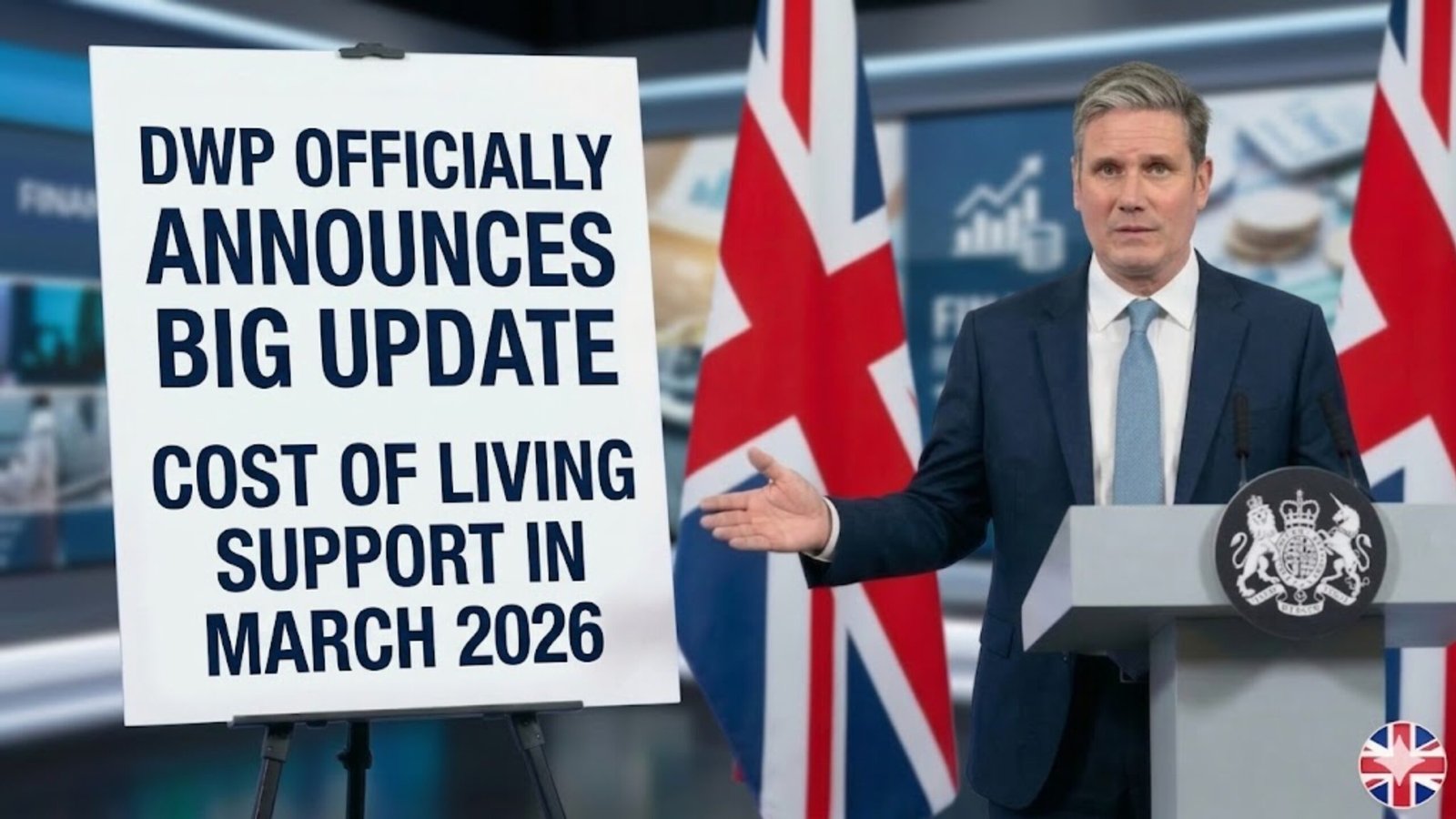
The Department for Work and Pensions (DWP) has recently issued a major update regarding the future of financial assistance for households across the United Kingdom. As we navigate through March 2026, many families and pensioners have been eagerly waiting to hear whether the one-off “Cost of Living Payments” that defined the last few years would return. The official stance is now clear, and while some news might be disappointing for those hoping for direct cash injections, there is a broader package of support and benefit increases that everyone needs to be aware of.
The Shift from One-Off Payments
For the past few years, the DWP provided multi-hundred-pound payments directly to bank accounts to combat the energy crisis. However, the update for 2026 confirms that the government is moving away from these temporary “emergency” payments. Instead, the focus has shifted toward permanent benefit increases and localized support. The DWP has officially stated that no further broad-scale Cost of Living Payments are planned for the 2026/27 financial year.
This decision marks a significant transition in how the UK government manages inflation and household costs. The logic is to integrate support into the existing benefit system rather than relying on sporadic, one-off grants. For many, this means checking their monthly statements rather than waiting for a separate lump sum to arrive.
3.8% Benefit Increase from April 2026
To compensate for the lack of one-off payments, the DWP has confirmed a 3.8% increase in inflation-linked benefits, which will officially kick in next month. This increase applies to a wide range of support, ensuring that monthly income for the most vulnerable keeps pace with the rising costs of essentials like food and transport.
The benefits set to rise include:
-
Universal Credit
-
Personal Independence Payment (PIP)
-
Disability Living Allowance (DLA)
-
Carer’s Allowance
-
Employment and Support Allowance (ESA)
-
Housing Benefit
For a single person over 25 on Universal Credit, this 3.8% rise will provide a noticeable monthly boost, helping to cushion the blow as the specific “Cost of Living” cash drops end.
Triple Lock and Pension Increases
Pensioners are receiving a more substantial update in this March announcement. Due to the “triple lock” commitment, the State Pension is set to rise by 4.8% starting in April 2026. This increase is driven by wage growth, which outperformed inflation during the assessment period.
The new full State Pension will increase from £230.25 to approximately £241.30 per week. For those on the basic State Pension, the weekly amount will rise from £176.45 to £184.90. This update is vital for the millions of retirees who do not have the flexibility to increase their income through work and remain highly sensitive to energy price fluctuations.
Household Support Fund Extended
One of the most critical parts of the March 2026 announcement is the extension of the Household Support Fund (HSF). While the DWP isn’t sending out national payments, they have allocated hundreds of millions of pounds to local councils across England, Scotland, and Wales.
The HSF is now active until March 31, 2026, and beyond into the next fiscal year. This fund allows local authorities to provide “crisis support” to residents. This might come in the form of supermarket vouchers, energy bill credits, or small cash grants of up to £150. Because this is managed locally, you must apply through your specific local council rather than waiting for the DWP to contact you.
Scrapping the Two-Child Limit
In a move that will affect thousands of families, the government has confirmed that the controversial “two-child limit” on Universal Credit and Tax Credits is being phased out starting in 2026. This means that families will be able to receive support for all their children, regardless of when they were born or how many are in the household.
For larger families who were previously capped, this update represents a significant increase in their monthly household income. The DWP estimates that this change will lift thousands of children out of relative poverty, providing a more stable form of “cost of living” relief than the previous one-off payment system.
New Universal Credit Standard Allowances
The March update has also clarified the new standard allowance rates for Universal Credit. Starting April 6, 2026, the rates will be adjusted as follows:
-
Single and under 25: Increasing from £311.68 to £338.58.
-
Single and 25 or over: Increasing from £393.45 to approximately £408.40.
-
Joint claimants (both over 25): The combined allowance is seeing a similar 3.8% upward adjustment.
These figures are the baseline for what households receive before any housing elements or child additions are calculated. It is important to check your “Journal” on the Universal Credit portal to see how these new rates will specifically apply to your circumstances.
Changes to Disability Support (LCWRA)
The DWP has also introduced changes to the “Limited Capability for Work and Related Activity” (LCWRA) element of Universal Credit. Starting in 2026, the criteria for the higher-tier disability payment are being tightened for new claimants.
Those who are already receiving the LCWRA payment will generally be “grandfathered” into the old system and won’t see a reduction. However, new applicants will face a more rigorous assessment focusing on “severe conditions.” If a new claimant meets the criteria, they could receive a higher monthly amount of £429.80, but those with less severe conditions may be placed on a lower tier.
Energy Bill Reductions and Support
While the £400 energy rebates of the past are gone, the DWP and Department for Energy Security have confirmed an average reduction of £150 on household energy bills for 2026. This is being delivered through a combination of the Warm Home Discount and a new “Energy Relief” credit that will be applied directly to electricity accounts.
If you are on a low income or receive certain benefits like Pension Credit, you should ensure you are registered for the Warm Home Discount. In 2026, this is usually applied automatically, but it is worth verifying with your energy supplier this month to ensure you don’t miss out on the £150 credit.
Cold Weather Payments in March
As the UK often experiences cold snaps in March, the DWP has reminded residents that the Cold Weather Payment scheme remains active until March 31. If the temperature in your area is recorded as (or forecast to be) zero degrees Celsius or below for seven consecutive days, you are entitled to a £25 payment.
These payments are automatic for those on Universal Credit, Income Support, or Pension Credit. If you haven’t received a payment despite a local freeze, you can use the DWP’s online “Cold Weather Payment Checker” to see if a trigger was reached in your postcode.
Support for Working Parents
March 2026 brings an expansion of childcare support that the DWP claims is a pillar of their “living standards” strategy. Eligible working parents of children aged 9 months to school age can now access 30 hours of government-funded childcare.
The goal is to help parents return to the workforce or increase their hours, which the government argues is the best long-term solution to the cost of living crisis. Additionally, “Breakfast Clubs” are being rolled out nationwide in primary schools, helping to reduce the daily food costs for millions of families.
How to Check Your Eligibility
With so many changes happening at once, it is easy to get confused. The DWP suggests that all claimants use an independent benefits calculator (like those provided by Entitledto or Turn2us) this month.
By inputting your current 2026 data, you can see if the new rules regarding the two-child limit or the benefit uprating make you eligible for more money. Many people are still missing out on Pension Credit, which is often the “passport” to other forms of support like the Warm Home Discount and free TV licences for those over 75.
Act Before the Financial Year Ends
The DWP’s “Act Before Late” advice for March is to ensure all your details are up to date before the new financial year begins in April. If you have had a change in circumstances—such as a change in rent, a new baby, or a health condition—reporting it now ensures that your April payments reflect the new, higher rates correctly.
Furthermore, if you are struggling with debt, the DWP has highlighted the “Breathings Space” scheme, which gives you 60 days of legal protection from creditors while you seek professional advice. This is a crucial tool for those whose finances have been stretched by the transition away from the old Cost of Living Payments.
Summary of the March 2026 Outlook
While the era of “free” £300 checks from the DWP has ended, the 2026 update shows a government trying to bake support into the permanent system. Between the 3.8% benefit rise, the 4.8% pension boost, and the scrapping of the two-child cap, many households will find that their monthly income increases steadily rather than in one-off bursts.
The key to navigating these changes is staying informed and being proactive with local council funds. The Household Support Fund is your primary resource for emergency help this year, so do not hesitate to reach out to your local authority if you are falling behind on essentials.