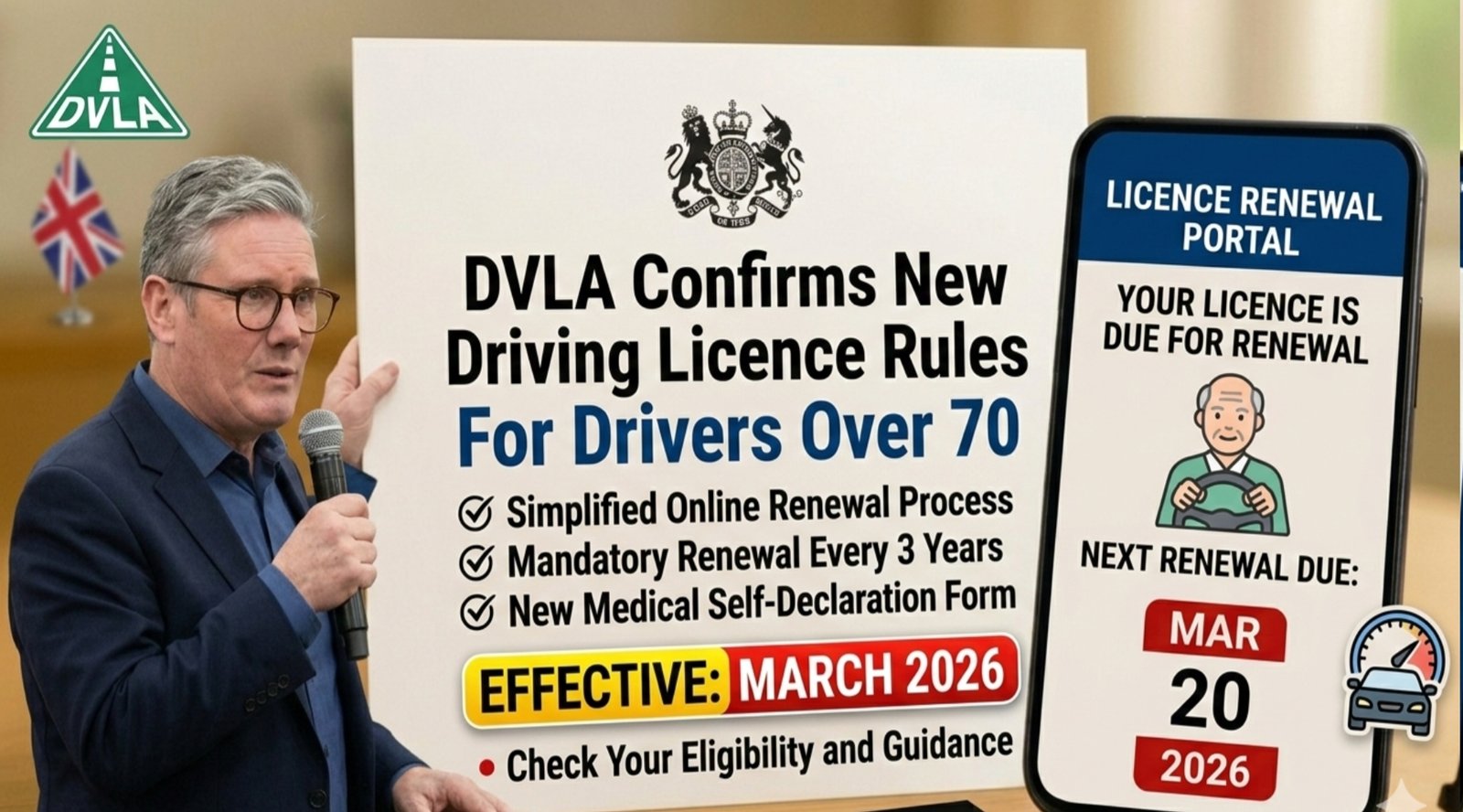
Getting a reminder through the post that your driving licence is about to expire can be a daunting moment, especially as you approach your 70th birthday. In the UK, turning 70 marks a significant shift in how the Driver and Vehicle Licensing Agency (DVLA) manages your right to be on the road.
As of March 2026, the DVLA has clarified the rules to ensure that the process remains fair while prioritising road safety for everyone. If you or a loved one are navigating these updates, it is essential to separate fact from the “pensioner ban” rumours often seen on social media.
This comprehensive guide breaks down exactly what has changed, what remains the same, and how you can keep your independence behind the wheel.
The End of Automatic Renewal
The most important rule to remember is that your driving licence does not automatically renew once you hit 70. Up until this point, most UK drivers have a photocard that is valid for ten years. However, the moment you reach your 70th birthday, your current licence technically expires.
To continue driving legally, you must proactively apply for a new one. The DVLA usually sends out a D46P reminder form about 90 days before your birthday. If you ignore this and continue to drive after your birthday without having submitted an application, you are technically driving without a licence, which can lead to hefty fines and will completely invalidate your car insurance.
Three Year Renewal Cycle
While younger drivers only have to think about their licence every decade, the rules for over-70s are stricter regarding frequency. Once you have renewed at 70, you must repeat the process every three years.
This isn’t a “test” of your ability, but rather a regular check-in to ensure your health hasn’t changed in a way that makes driving dangerous. The good news is that these three-yearly renewals are completely free of charge, provided you use the official GOV.UK website. Be very wary of third-party websites that look like the DVLA but try to charge you a £50 “admin fee”—these are often scams.
New Focus on Eyesight Standards
One of the biggest updates discussed in 2026 involves the “number plate test.” For decades, the standard has been that a driver must be able to read a car number plate from a distance of 20 metres.
While the physical distance hasn’t changed, the DVLA is now placing a much higher emphasis on self-declaration and professional eye checks. If you need glasses or contact lenses to read that number plate, you must wear them every single time you drive. In 2026, the DVLA has also been working more closely with opticians to encourage drivers over 70 to have a full eye test specifically before they sign their renewal declaration. If you sign the form saying your vision is fine when it isn’t, you could face prosecution if you’re involved in an accident.
Declaring Medical Conditions
The renewal form for over-70s asks a series of health-related questions. You are legally required to tell the DVLA about any “notifiable” medical conditions. This doesn’t mean you will automatically lose your licence, but it does mean the DVLA might need to contact your GP.
Conditions you must declare include:
-
Dementia or significant memory loss.
-
Parkinson’s disease.
-
Epilepsy or recent unexplained blackouts.
-
Insulin-treated diabetes.
-
Any condition affecting both eyes (such as glaucoma or cataracts).
In 2026, the DVLA has streamlined the digital “Medical Fitness to Drive” service, making it easier to declare these conditions online. If you are honest about your condition, the DVLA may issue a shorter licence (for one or two years) or ask you to have a clinical assessment, rather than taking your licence away entirely.
Loss of Specific Entitlements
A rule that often catches older drivers by surprise is the loss of “Grandfather Rights.” When you renew your licence at 70, you automatically lose the right to drive medium-sized vehicles (Category C1) and minibuses (Category D1).
If you still need to drive a motorhome that weighs between 3.5 and 7.5 tonnes, or if you volunteer to drive a community minibus, the standard renewal won’t be enough. You will need to fill out a D2 application form and provide a D4 medical report completed by a doctor. This involves a more rigorous physical exam to prove you meet the higher medical standards required for larger vehicles.
The Online Renewal Advantage
The DVLA is heavily pushing for over-70s to use the online renewal service rather than the traditional paper forms. There are several reasons for this, but the primary one is speed.
If you renew online, your new licence usually arrives within five working days. Postal applications, especially during peak times in 2026, can take up to three or four weeks. To renew online, you simply need your National Insurance number, a valid UK passport (to use your existing photo), and your addresses for the last three years. It is a secure, straightforward process that a vast majority of over-70s now prefer.
Section 88 of the Road Traffic Act
One of the most common fears is: “What if my licence expires while I’m waiting for the DVLA to process my renewal?” This is where “Section 88” comes into play.
Under Section 88 of the Road Traffic Act 1988, you may be allowed to continue driving even if your licence has expired, provided you have already sent your renewal application to the DVLA. However, there are strict conditions: you must have held a valid licence previously, your doctor must support your decision to continue driving, and you must not be currently disqualified. This rule provides a vital “safety net” for those who are waiting on the DVLA’s medical team to review their file.
Cognitive Health and Memory
In recent years, there has been more discussion regarding cognitive health for older motorists. While the DVLA does not currently require a mandatory “memory test” for everyone over 70, they have updated their guidance for 2026 regarding self-reporting.
If you notice that you are becoming confused at busy junctions, or if family members have expressed concern about your reaction times, the DVLA encourages a voluntary “Experienced Driver Assessment.” These are not “pass/fail” tests but are designed to give you an objective view of your driving. Being proactive about your cognitive health can often help you stay on the road longer by identifying small adjustments you can make to your driving habits.
Avoiding Third-Party Scams
Scammers are increasingly targeting UK pensioners by creating “copycat” websites that appear at the top of Google searches. These sites often use the Crown logo or similar branding.
Always look for the .gov.uk suffix in the website address. The official DVLA service for over-70s is free. If a website asks for your credit card details for a “renewal fee,” close the tab immediately. These sites simply take your information and pass it to the DVLA, charging you for a service you could have done yourself for nothing.
Voluntary Surrender of a Licence
Sometimes, a driver may decide that they no longer feel comfortable on the road. If you choose to stop driving, the DVLA makes it very simple to “voluntarily surrender” your licence.
This is a formal process that can actually make it easier to get your licence back in the future if your health improves (for example, after a successful surgery). Surrendering your licence also makes you eligible for certain local benefits, such as a free older person’s bus pass or discounted rail travel, helping you stay mobile without the stress and cost of running a car.
Insurance Obligations
Even if the DVLA says you are fit to drive, your insurance company has its own set of rules. You must inform your insurer of any medical conditions you have declared to the DVLA.
Failure to tell your insurer about a change in your health can result in a claim being rejected. In 2026, many insurers for over-70s are offering “telematics” or “black box” policies for older drivers, which can help lower premiums by proving that you are a safe, low-mileage driver.
Staying Mobile in 2026
The new DVLA rules aren’t designed to take away your freedom; they are designed to keep the UK’s roads among the safest in the world. By staying on top of your three-year renewal cycle, being honest about your health, and keeping your eyesight in check, you can continue to enjoy the independence that a car provides.
The key is to act early. Don’t wait until the week before your 70th birthday to start the process. Use the 90-day window provided by the DVLA to ensure a smooth transition into the next chapter of your driving life.