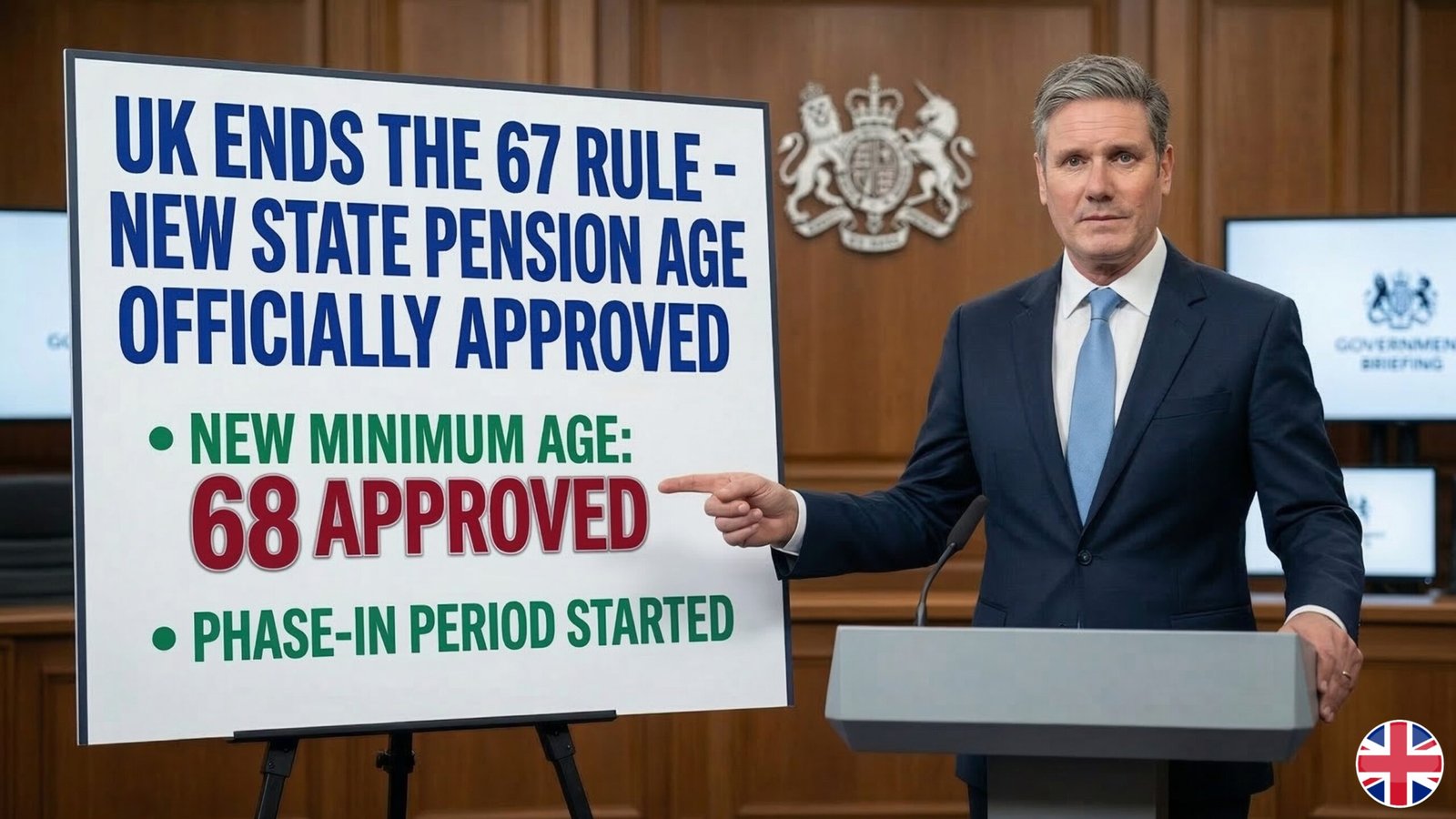
For millions of workers across the United Kingdom, the question of “when can I retire?” has just become much clearer—and for many, the answer is slightly further away than they had hoped. The Department for Work and Pensions (DWP) has officially moved forward with the transition that brings an end to the “66 rule,” shifting the goalposts for the State Pension age to 67.
This change isn’t a sudden surprise; it has been in the legislative pipeline for years. However, as of March 2026, the implementation phase has officially begun. If you were born in the 1960s, this update isn’t just a political headline—it is a direct change to your financial timeline. Understanding how this phase-in works is essential for anyone currently in their early 60s who is starting to count down the days to their retirement.
The End of the Age 66 Era
Since 2020, the State Pension age for both men and women in the UK has stood at 66. This was the benchmark that everyone looked toward. However, the “67 Rule” refers to the legislated increase that takes the retirement age from 66 to 67. This transition is not happening overnight for everyone; instead, it is being rolled out over a two-year window starting in April 2026 and concluding by 2028.
The shift is driven by a simple, albeit harsh, reality: people are living longer on average than they were when the pension system was first designed. To keep the State Pension sustainable for the Treasury, the government has determined that the age at which we claim must rise in tandem with life expectancy. While life expectancy growth has slowed recently, the move to 67 is now officially “set in stone” for the current cohort of workers.
Who is Affected by the Increase to 67
The most important thing for any UK resident to check is their date of birth. The rise to age 67 specifically targets those born on or after April 6, 1960. If you were born before this date, your pension age remains 66. If you were born between April 1960 and March 1961, you are in the “transition group.”
For this group, the pension age will increase in gradual steps of months rather than a full year all at once. For example, if you were born in mid-1960, you might reach your State Pension age at 66 years and 4 months, or 66 years and 9 months. By the time we reach those born after April 1961, the age of 67 becomes the absolute standard. This staggered approach is designed to prevent a “cliff edge” where people born just days apart have vastly different retirement dates.
Why the Government Approved the Change
The approval of this new timetable follows years of independent reviews. The DWP’s core philosophy is that people should spend a specific proportion of their adult life in retirement—typically around 31%. As medical advancements and lifestyle changes have extended the average lifespan, the “adult life” portion has grown, necessitating a later start for pension payments.
The financial pressure on the UK government is also a massive factor. The cost of providing the State Pension is one of the largest single expenditures for the taxpayer. By moving the age to 67, the government saves billions of pounds that would otherwise be paid out in that “extra” year of retirement. For the individual, however, it means another 12 months of either staying in the workforce or relying on private savings before the state support kicks in.
The Looming Debate Over Age 68
While the move to 67 is currently being implemented, there is already significant talk about the next jump: the increase to age 68. Current legislation suggests this won’t happen until the mid-2040s. However, several independent reviews have suggested that the government should bring this forward to the late 2030s to save more money.
As of early 2026, the government has decided to stick to the “67 by 2028” plan while delaying a final decision on the “68 rule.” They have committed to providing at least 10 years’ notice before any further increases are made. This gives younger workers some breathing room, but the message is clear: the trend for the State Pension age is only going in one direction—up.
Impact on the Normal Minimum Pension Age
The change to the State Pension age doesn’t just affect when you get money from the government; it also affects when you can access your own private or workplace pensions. This is known as the Normal Minimum Pension Age (NMPA).
Traditionally, the NMPA is set 10 years below the State Pension age. Currently, most people can access their private pots at age 55. However, this is officially scheduled to rise to 57 on April 6, 2028. This alignment ensures that people don’t exhaust their private savings too early, leaving them with nothing but the State Pension later in life. If you were planning to “bridge” the gap between 55 and 66 with your private pension, you may now need to rethink that strategy if you fall into the 1960s birth bracket.
How to Check Your Specific Retirement Date
Because the transition is staggered, many people are left confused about their exact “Freedom Day.” The DWP has updated the “Check your State Pension age” tool on the GOV.UK website to reflect the 2026 changes.
By entering your date of birth, the tool provides a specific date on which you can claim. It also provides a “Pension Forecast,” which tells you how much you are likely to receive based on your National Insurance record. It is highly recommended that anyone over the age of 55 checks this tool at least once a year, as it is the most accurate way to plan your exit from the workforce.
The Financial Gap for the Over-60s
For a person expecting to retire at 66, an extra year of work can be a daunting prospect, particularly for those in physically demanding jobs. The gap between age 66 and 67 represents a “loss” of roughly £12,000 in expected State Pension income (based on current rates).
To fill this gap, many UK workers are looking at “phased retirement,” where they reduce their hours rather than quitting entirely. Others are increasing their voluntary National Insurance contributions to ensure that when they finally do reach 67, they receive the “Full New State Pension” rate rather than a reduced amount. Every year of contributions adds about £300 to your annual pension for life, so it is a gap well worth filling.
National Insurance Gaps and the 2026 Deadline
With the pension age rising, the number of “qualifying years” you need becomes even more critical. To get the full rate at age 67, you generally need 35 years of National Insurance contributions.
There is currently a window of opportunity for people to buy back missing years of NI going back to 2006. However, this “generous” look-back period is expected to be tightened in the coming years. If you are reaching your 60s and realize you have gaps in your record from your younger years, now is the time to act. Paying a few hundred pounds now could result in thousands of pounds of extra income over a 20-year retirement.
Preparing for a Longer Working Life
The official approval of the 67 rule has sparked a wider conversation about ageism in the UK workforce. If the government expects people to work until 67, there must be viable roles for older workers. Many companies are now introducing “Mid-life MOTs” to help employees in their 50s and 60s reskill or adjust their roles to stay in employment longer.
For the individual, the shift to 67 requires a mental adjustment. Retirement is no longer the “early 60s” event it was for our parents. It is now firmly a “late 60s” milestone. Planning for this means ensuring your health and your finances are robust enough to handle that extra time in the labor market.
Health and Wealth in the 67 Era
One of the major criticisms of the rising pension age is the disparity in “healthy life expectancy.” While someone in a wealthy part of the UK might be perfectly healthy at 67, someone in a deprived area may have chronic health issues by their early 60s.
For those who simply cannot work until 67 due to ill health, the State Pension is not the only option. The DWP provides Personal Independence Payments (PIP) and Employment and Support Allowance (ESA) for those under the state pension age who have disabilities or health conditions. Understanding these benefits is crucial for those who find the rise to 67 an impossible hurdle to clear.
Managing the Transition Socially and Financially
Retirement is as much a social transition as a financial one. When the “67 Rule” was just a distant possibility, people could ignore it. Now that it is officially being implemented in 2026, it is time to have serious conversations with family and employers.
If you are part of a couple where one person is older, the staggered age increases can create a gap where one partner is retired and the other is still forced to work for another 18 months. Planning for this “staggered retirement” is the new reality for UK households. It requires a detailed look at joint savings and a shared vision of what those final working years will look like.
Future Outlook for the UK State Pension
As we look beyond 2026, the State Pension age will likely remain a hot-button political issue. With the “Triple Lock” keeping pension payments high and the age of eligibility rising, the balance between supporting the elderly and being fair to young taxpayers is a delicate one.
For now, the “67 Rule” is the new law of the land. It represents a significant shift in the British social contract. By accepting that 67 is the new 66, UK residents can take control of their future, adjust their savings plans, and ensure that when they do finally reach that milestone, they are ready to enjoy it to the fullest.